The Limits of (Existing) Demand
 Gregg Blanchard /
My daughter just had one of those moments that marketers know and love: her first sale. It came on our little side project – Anniversary Logos – after we put in some extra effort these last couple months to get it ready to monetize by building a simple logo maker and adding sponsorship slots.
Now that the potential for revenue exists, we’ve been talking through how to grow. And, specifically, the idea of demand.
For the vast majority of smaller SaaS companies – anniversary logo makers very much included – there is a pool of existing demand. These are the people who, based on a bunch of different factors, a going to search for “competitor email tracking” or “race management software” (or some semi-related topic/question) today. They are already demanding the thing you’re selling.
As a smaller SaaS marketer, this is typically my highest converting, highest ROI audience.
This is my core.
The trick, however, is that there are only so many people out there on any given day who fit this level of demand. We work in niches and niches have limits. There is no endless, universal demand for, say, food three times a day you can tap into like a restaurant. There may only be 37 people out there who will search for “resort booking engine“.
And that’s it.
Which is the other side of this coin. Yes, this demand already exists whether you do any marketing today or not, but it also has very defined limits. Limits that are really hard to change, especially for a small company with limited resources.
I loved how Justin Jackson described this when he wrote about waves of demand:
“Business is like surfing: the founder paddles out past the break, sits on their board, and evaluates the waves (the business opportunities) coming in. Specifically, they’ll observe the size, shape, and momentum of customer demand.”
I agree 100% with Justin’s suggestion that entrepreneurs should follow big waves of demand when choosing business ideas. Why? Because you only have to capture demand instead of create demand, and creating demand (which I’d imagine is something I’ll write about soon) can be a long, tough, uphill battle even for the biggest companies with the deepest pockets, much less a scrappy team of 3 like mine.
But as a marketer of a smaller SaaS, you’re likely marketing an existing product. What do you do if the business and target customer is already set? You can’t choose a new wave, your job is simply to capture as much of your existing wave as possible.
Which is what my daughter and I discussed.
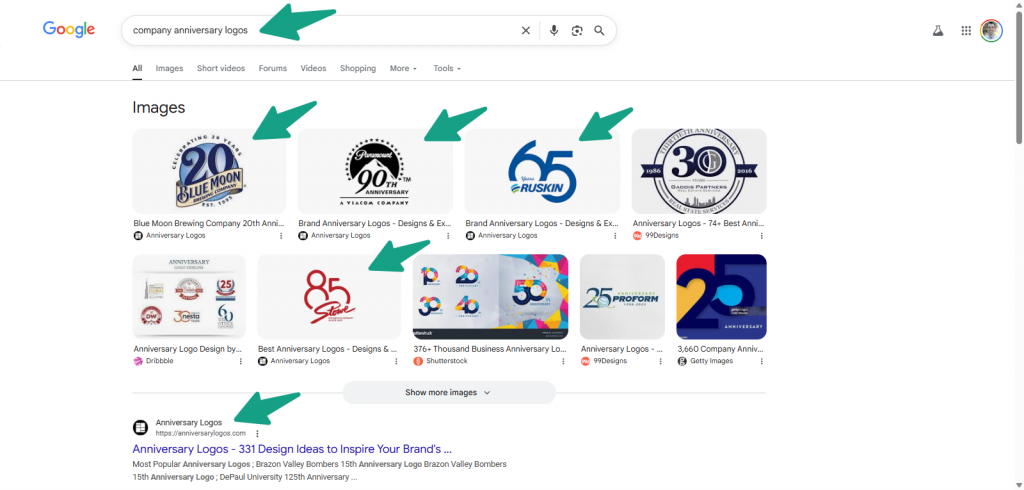
We sat down and starting looking at our analytics. Our primary channel is SEO and, based on our Search Console data, we’re already ranking #1 (or just about #1) for many of our core search phrases in terms of both image results and site results. This was great to see.
But the key is in that word; most.
Because as we dug into deeper we found two interesting things.
- First, we found places where we’re not ranking quite as high (we average #9 for “corporate anniversary logos”) and how we ranked higher when we had more logos in a category.
- Second, was how much of our new traffic is coming from people looking for specific logos (we average #8 for “america 250 logo”, but it accounted for 10% of our traffic one day).
What I explained to her was that these two insights are showing us where the site’s growth will likely come from: adding more (especially well-known) logos to the site. That’s our fuel for growth.
So, she made a goal of reaching 450 logos on the site by the end of the year.
At some point she will capture as much of the anniversary logo demand as she can, but the key is that she’s not there yet…
…which is how I want to wrap this up.
If I’m honest, that conversation caused a decent bit of introspection about how well I’m capturing existing demand for the smaller SaaS products I market. In some cases, I feel pretty good and don’t see much left in the well. In others, I’m not as sure and I’m sensing there might be more left in the tank. So, that’s exactly what I’ve started to do the last couple weeks: ensure that I’m capture as much of that existing demand as possible before I put any more of my limited resources on the much harder task of (trying to) create demand on my own.